The Canterbury Tales storytelling contest rules
The Canterbury TalesThe Canterbury Tales storytelling contest rules transform the pilgrimage to Canterbury from a shared act of travel into an organized contest of speech, judgment, and fellowship. Harry Bailly’s scheme gives the pilgrims a common purpose beyond reaching a shrine: each must contribute stories, obey a procedure, and accept a public standard by which storytelling will be assessed.
Purpose and Setting
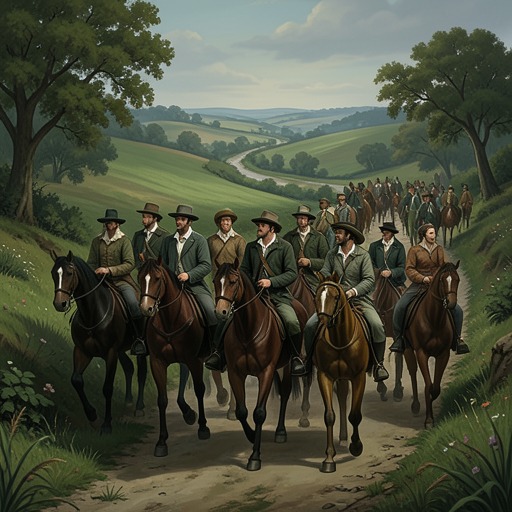
The contest is proposed within the company gathered for pilgrimage. The travelers have set out toward Canterbury, where pilgrims desire to visit distant shrines, and Harry Bailly presents storytelling as a way to make the journey more agreeable. His plan joins sacred movement with secular entertainment: the road remains directed toward the shrine of the blissful martyr, but the travelers’ time on that road is filled by a formal exchange of narratives.
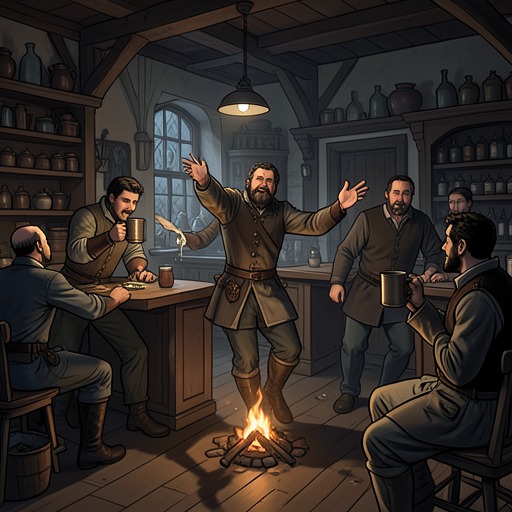
Harry frames the proposal as an act of hospitality and collective amusement. He urges the company to go to Canterbury under divine blessing, then offers a practical means of passing the hours of travel. The rules therefore arise from the circumstances of the journey itself. The contest is not an isolated performance staged in a court or hall; it is a moving institution whose participants remain companions, witnesses, and critics while they travel.
Contest Structure
Each pilgrim is required to tell two tales on the outward journey to Canterbury and two more on the return. The rule establishes a substantial narrative obligation and distributes participation across the entire expedition. Storytelling is not reserved for a single favored voice: every member of the company is expected to speak, so the pilgrimage becomes a sequence of competing and answering perspectives.
The contest also has a clearly defined reward. The person judged to have told the tales best in both purpose and wit wins a supper paid for by the company at the Tabard when the travelers return from Canterbury. The prize links narrative excellence to communal celebration, while the promised meal gives the contest a future endpoint. Success is not merely private applause; it culminates in a shared feast at the place from which the pilgrimage began.
Authority and Enforcement
Harry Bailly claims responsibility for the practical government of the undertaking. He offers to ride with the pilgrims at his own expense and serve as their guide, presenting personal generosity as the basis of his authority. The company accepts his proposal and gives him its oath, thereby converting an informal suggestion into an agreed arrangement. His position as governor of the contest rests on collective consent as well as his own initiative.
The Host is also assigned the role of judge. He is to hear the tales and determine which performances meet the contest’s standard, while anyone who disputes his judgment must pay for the expenses incurred along the way. This provision makes disagreement materially costly and protects the continuity of the game. The rules thus establish not only a reward for excellence but also a mechanism for maintaining order when the pilgrims’ opinions conflict.
Order of Performance
Before the company travels farther, the pilgrims are to draw lots. The person who draws the shortest lot must begin. This procedure prevents the first speaker from being chosen solely by rank, wealth, or force of personality, and it supplies the contest with an apparently impartial opening. Chance determines the initial position, while Harry’s judgment governs the evaluation that follows.
The sequence created by the lots also shapes the work’s larger form. Once one pilgrim has spoken, later tales can be heard as responses, contrasts, interruptions, or retaliations, even though the original rule presents the game as a simple method of passing the time. A fixed order turns a collection of individual stories into a social conversation, and the authority to judge turns that conversation into a contest.
Narrative Significance
The rules create the frame through which the pilgrims become narrators. They provide a recurring movement between travel and telling, sacred destination and worldly performance, individual voice and communal regulation. The outward and homeward journeys give the company a temporal structure, while the promised supper gives the storytelling an imagined conclusion even as the tales continually open new disputes and exchanges.
The arrangement also makes fellowship conditional rather than effortless. The pilgrims swear to Harry’s governance and accept the financial penalty attached to resistance, so companionship is maintained through explicit obligations. At the same time, the freedom to tell different kinds of tales allows social distinctions, moral disagreements, and rival claims to authority to surface within the common journey. The contest’s decisive achievement is therefore formal as well as comic: it converts a group of travelers into a temporary narrative society governed by vows, lots, judgment, reward, and the expectation of return.